


The Second World War ushered in an era of challenge, change and growth for the Manitoba agriculture sector.
One development of the war years was the construction of a vegetable oil-crushing plant, Co-operative Vegetable Oils Ltd., in Altona, Manitoba in 1943. This plant was the beginning of the crush industry in Western Canada. The war had reduced imports of vegetable oil into Canada from Russia and Argentina along with creating an increased demand for vegetable oils in Canada. While there was a crush plant in Eastern Canada at the time, the cost of rail freight to the East reduced the price of oilseeds on the Prairies.
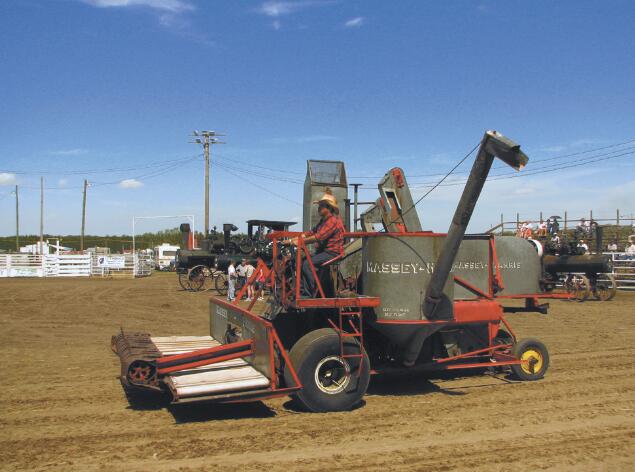
Another development of the war years was the Canadian government aided the Canadian farm machinery manufacturers to convert them to war production which meant the purchase of new production equipment, hiring engineers and retraining staff to operate the new equipment and learn new production processes. The capacity of these manufacturers improved greatly. With the end of the war in 1945, a flood of pent-up demand for new equipment immediately appeared. The self-propelled combine rapidly became common on Manitoba farms along with new tractors, trucks and machinery of all sorts. Horse traction was largely retired in the years after 1945.
Life on the farm was significantly eased after 1945 by two developments: rural electrification and the building of a modern road network by all levels of government. Rural electrification had begun in 1938 but was suspended with the outbreak of war and restarted with vigour in 1946. Not only were modern appliances and equipment available in farm homes and shops, the sheer convenience of having a power source available at any time merely at the flip of a switch made life far more easy Agricultural Processing Equipment.
The capacity of road-building machinery had increased during the war years along with the cost of such machinery falling. Municipalities and the provincial government embarked upon road improvement and building programs. The federal government became involved in highway construction through the Trans-Canada Highway Act of 1949 with construction on the Trans-Canada beginning in 1950. With modern roads appearing, the ability of more around in rural areas, particularly during wet weather and the winter was greatly enhanced.
Agricultural Processing Equipment
Another development of this period was the increased use of chemical fertilizers and pesticides on farm. While Cominco had begun fertilizer production at its Trail, B.C. smelter in 1931, economic conditions did not warrant the use of fertilizer in many areas of the Prairies in the 1930s.
