


Karmen (Riegsecker) Clark grew up five minutes down the road from the Goshen farm she now calls home. Tim Clark, more than 650 miles away on a dairy farm in western New York.
From there, their herd — and family — began to multiply. Tristian, now 20, came next, followed by two daughters, Tessa, now 18, and Taryn, 17. All four children attended Bethany Christian Schools.
For a few years, Tim milked the goats by Milking Machine. When their herd reached 18, they purchased a small milking machine and, in the late 1990s, entered the commercial milking business. In the fall of 2001, they purchased Tuckhill Farm in Goshen.
About the herd
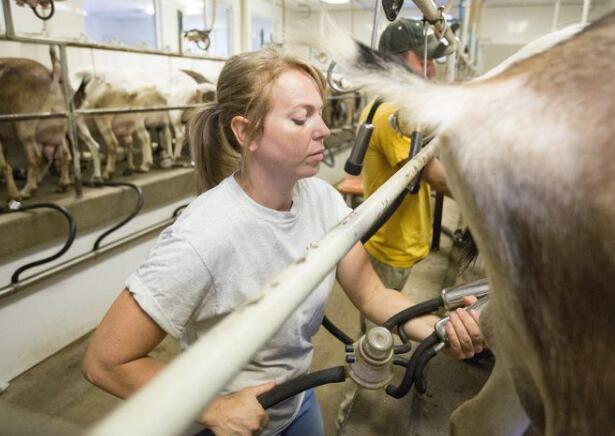
Today, the Clark’s goat herd includes three primary goat breeds — Lamanchas, Saanens and Alpines — flanked by others they’ve picked up along the way including Toggenburgs, Oberhasli, Nubians, Boers, Angoras and a fan favorite known as the mini Pygmy.
The size of the herd varies year to year and season to season, Tim explained. The head count typically ranges from 1,000 to 1,700. It takes about 60 small, square bales of hay a day to feed the herd, he added.
It didn’t take long for Tim and Karmen to realize the benefits of staggering the kidding process.
On the one hand, it helped them level out their milk supply and production. Like most mammals, the highest supply of milk comes after goats “freshen,” a term used to describe when milk production begins.
On the other hand, it means little break from babies.
There are times during the year that Tim bottle feeds as many as 300 baby goats. Right now, that number is closer to 85 and takes about 20 to 25 minutes to complete the chore, he added.
“Baby season is never ending for us,” he said. “On average, we have about 1,500 to 1,600 babies born in a year. Two were born last night and 10 are due in the next week Milking Machine.”
But none of that compares to the Clark’s record-breaking 27 babies born in one day. It was wild, the couple said.
Benefits of goats
Studies indicate that goat's milk — primarily for its use in the cheese-making process — and meat consumption is on the rise, Tim said.
“It’s the fastest-growing ag industry right now,” Tim said, explaining how restaurants and even some grocery stores have begun introducing goat cheese as an option for salads and other meals.
According to the U.S. Department of Agriculture’s National Agricultural Statistics Service, the number of dairy goat operations has been growing steadily since 1997. Back then, of the 15,451 operations counted nationwide, Indiana had 600. By 2007, the number grew to 1,070 of 27,481 and, as of 2012, totaled 1,123 of 29,570.
According to a 2016 survey, Indiana had 11,500 dairy goats.
